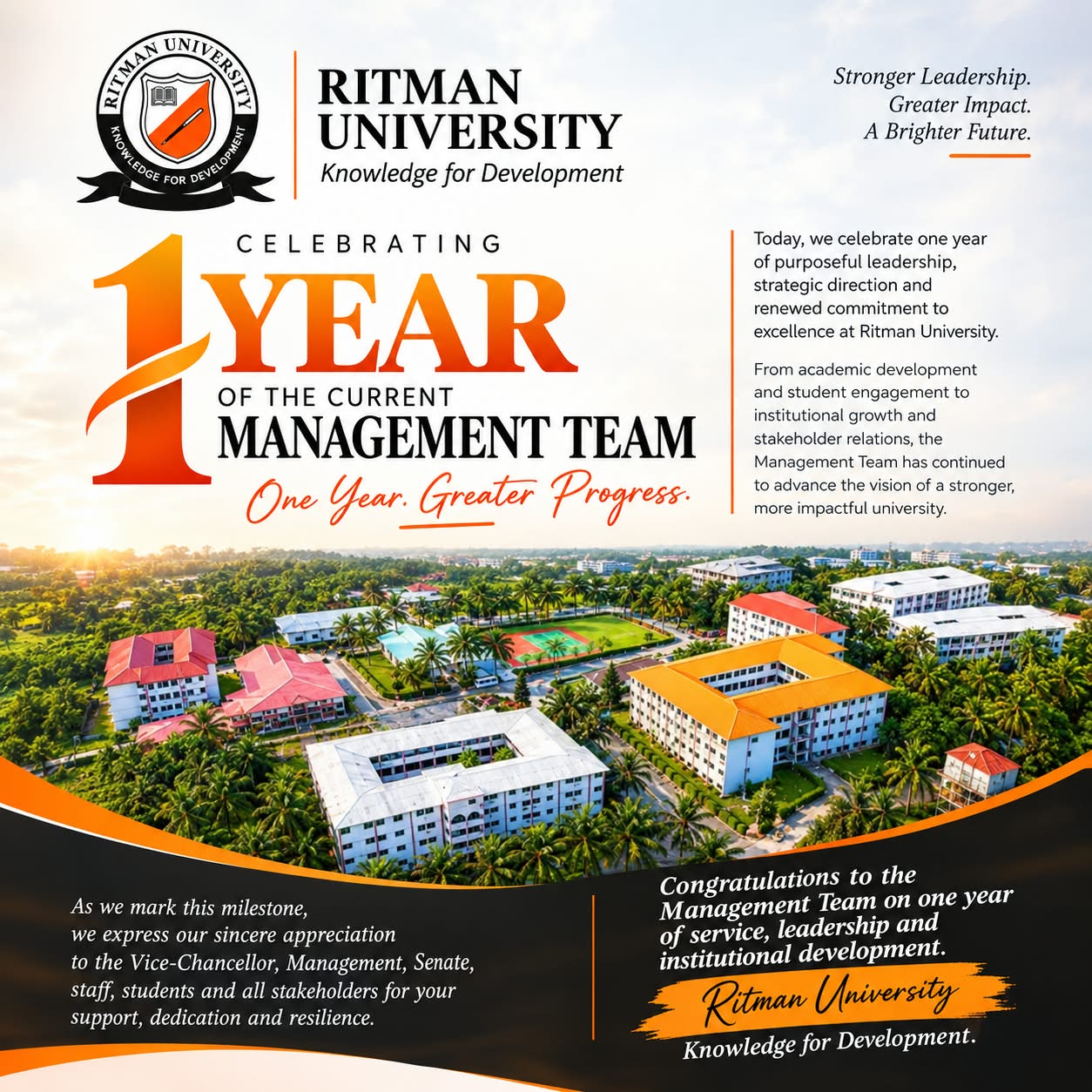

Ritman University marks another significant milestone as the present Management Team, led by the Vice-Chancellor, Prof. Akan B. Williams, completes its first year in office.
Prof. Williams assumed duty as the second substantive Vice-Chancellor of Ritman University on October 2, 2025, beginning a new chapter in the University’s journey of academic development and institutional growth. Over the past twelve months, the Management Team has pursued a deliberate programme of repositioning the University, with emphasis on academic expansion, quality assurance, staff development, student discipline, financial responsibility, digital transformation, infrastructure and institutional visibility.
The first anniversary therefore presents an opportunity not merely to celebrate one year in office, but to reflect on what has been achieved, what has changed and the foundations that have been laid for Ritman University’s next phase of growth.
Perhaps one of the most significant developments of the past year has been the expansion of Ritman University’s academic offerings. Under the present administration, the University was given approval to establish 22 new academic programmes, following successful NUC Resource Assessment visits facilitated by the immediate past administration led by the Acting Vice-Chancellor, Prof. Essien Udosen. The total number of programmes has increased to 40, while the number of Faculties has grown from three to six. This represents a major expansion of the University’s academic scope and creates wider opportunities for prospective students seeking quality higher education within Akwa Ibom State and beyond.
The University’s commitment to academic quality has also yielded notable regulatory milestones. Full NUC accreditation was granted to the English, History & International Studies, and Industrial Chemistry programmes, with accreditation scores of 89.2%, 94.4% and 82.6% respectively. The successful programmes are expected to retain their accredited status until 2030.
Even more significantly, 18 NUC Resource Assessment Teams are on ground as the University marks this anniversary, assessing resources for the proposed establishment of 18 postgraduate programmes spanning PGD, Master’s and Ph.D. levels. At the same time, separate NUC Resource Assessment Panels are assessing the proposed unbundling of the University’s Mass Communication programme into six standalone programmes: Advertising, Broadcasting, Public Relations, Journalism and Media Studies, Film and Multimedia Studies, and Development Communication. These developments point to an institution not merely expanding in size, but deliberately positioning itself for greater academic depth and postgraduate education.
The administration has also demonstrated a strong interest in preparing Ritman University for the demands of a rapidly changing world. An Artificial Intelligence Policy has been instituted, while the University has become an academy for the Cisco Academy programme, opening another avenue for technology-oriented learning and professional development. An Accounting Technicians Scheme West Africa (ATSWA) tutorial centre has also been established. The Memorandum of Understanding with MAHSA University, Malaysia, further reflects the University’s efforts to build relationships beyond its immediate environment and create opportunities for broader academic collaboration.
In another landmark development, Professor Celestine Ntuen, the University’s premier Vice-Chancellor, became its first Emeritus Professor, in recognition of his contribution to the development of the institution. Beyond establishing new programmes, Management has pursued improvements in academic processes and documentation, including the adoption of more structured formats for examination questions and the full institution of an external examination system. These reforms reflect an effort to strengthen the systems behind academic delivery and promote greater consistency, accountability and quality assurance across the University’s academic processes.
The past year has also been significant in the area of staff development and welfare. Management provided working tools to University officials, hosted staff training programmes, confirmed several academic and non-academic appointments, and promoted many academic and non-academic staff. Two members of staff were promoted to the rank of Associate Professor. The University also recorded the institution of an automatic appointment pathway for outstanding NYSC members, with one beneficiary already appointed, while annual normal increments were effected for eligible regular staff. Further strengthening the academic workforce, 11 visiting Professors/Lecturers were appointed for the new programmes, while six academic staff obtained their Ph.Ds during the period under review. The conditions of service for staff were also reviewed. These developments demonstrate that the expansion of the University has been accompanied by deliberate attention to the people responsible for delivering its academic mission.
The administration’s interventions also extended to staff welfare and institutional administration. A verification exercise was conducted, resulting in the reclassification of some staff, while the salaries of 45 staff members were harmonised. An e-attendance management system has improved punctuality. The University also inaugurated the Congregation and conducted elections for representatives of Senate and Congregation into the 3rd Governing Council led by Prof. Stephen Azaiki, further strengthening institutional participation in governance.
The present administration has equally introduced measures aimed at promoting discipline and responsibility among students. The implementation of a corporate dress code, the enforcement of a 75 percent attendance requirement for examinations, a review of the Student Handbook and efforts towards reducing student misconduct have all formed part of the administration’s approach to improving the student experience. The University has also recorded increased student enrolment during the period. These measures have been complemented by student-centred activities, including matriculation, Students’ Week, inter-faculty sports and student leadership activities, contributing to a more engaging campus experience.
The past year has also seen a deliberate effort to increase the University’s academic and public visibility. Academic staff have been encouraged to establish and maintain researcher profiles on Scopus, Web of Science, Google Scholar and ORCID, with the University now visible on Elsevier Scopus. Management has also facilitated preparations for an international conference in collaboration with the African Policy and Research Consortium (APRC), while the University’s engagement with the press and electronic media has strengthened its public communication. The publication of the University’s maiden e-newsletter, website updates, effective online marketing and the use of official email communication channels have further contributed to the University’s digital visibility.
Perhaps among the most consequential achievements of the year were interventions in the University’s financial obligations. The establishment of the Ritman University Staff Welfare Multi-Purpose Co-operative Society Limited, with certification from the State Bureau of Cooperatives, also provides a structured platform for staff welfare and financial cooperation. These interventions represent important steps towards strengthening financial stability and staff confidence in the institution.
Infrastructure development has remained another important component of the University’s repositioning. The University has provided a 156 KVA solar energy system on campus, representing a significant investment in alternative power supply and campus infrastructure. Management has also undertaken an overhaul of the University’s security architecture, alongside interventions concerning vendors operating at the cafeteria and shopping centre. Together, these initiatives contribute to the broader objective of creating a more secure, functional and conducive environment for teaching, learning and administration.
The administration has also recognised the importance of maintaining a strong relationship with Ritman’s graduates. Strategic and capacity-building meetings have been held with the Alumni Association, while the Alumni President has been appointed as a member of the Governing Council. This creates a stronger avenue for alumni participation in the University’s institutional development and governance.
Beyond physical and academic developments, the past year has also seen attention to institutional culture. The administration introduced regular Monday morning devotion and Management meetings, established the Chapel of Grace as a non-denominational Christian centre, and instituted opening and departure assemblies for students and staff. The University also hosted a New Year Solemn Assembly. A culture of punctuality has similarly been promoted across meetings and institutional activities. These initiatives form part of the administration’s broader emphasis on values, discipline, responsibility and a positive institutional culture.
As Ritman University celebrates the first anniversary of the present Management Team, the story of the past twelve months is therefore one of expansion, consolidation and repositioning.
From 22 new programmes and the expansion from three to six Faculties, to full accreditation of three programmes; from preparations for 18 postgraduate programmes to the proposed unbundling of Mass Communication; from staff promotions, the provision of a 156 KVA solar power system to the University’s growing digital and international visibility, the period has produced significant institutional developments.
Yet, these achievements are not presented as an endpoint. They represent a foundation for the next chapter. The University acknowledges that every milestone has been made possible through the collective commitment of Management, Senate, academic and non-academic staff, students, alumni, parents, partners and other stakeholders who continue to contribute to the growth of Ritman University.
As the Management Team completes its first year in office, the University celebrates not only the leadership of the Visitor, Distinguished Senator Emmanuel Ibok Essien, that has guided these developments, but also the collective Ritman spirit that continues to drive the institution forward. With gratitude for the journey so far and renewed confidence in the future, Ritman University looks forward to building on these gains and advancing its mission of providing quality education and producing knowledge that contributes meaningfully to society.
One Year. One Vision. Remarkable Progress
Congratulations to the Ritman University Management Team on One Year in Office.
RITMAN UNIVERSITY,
Knowledge for Development